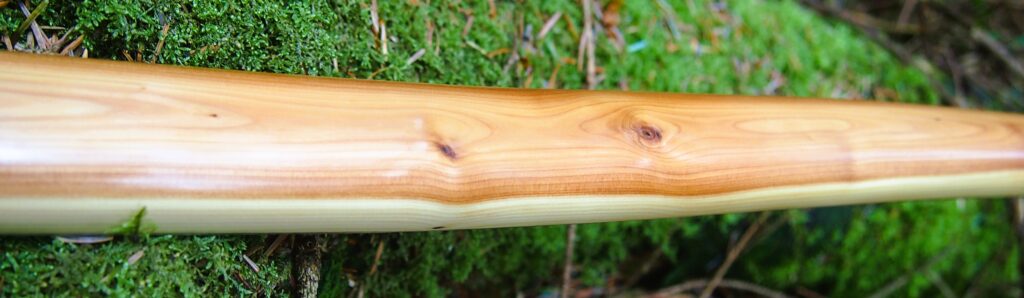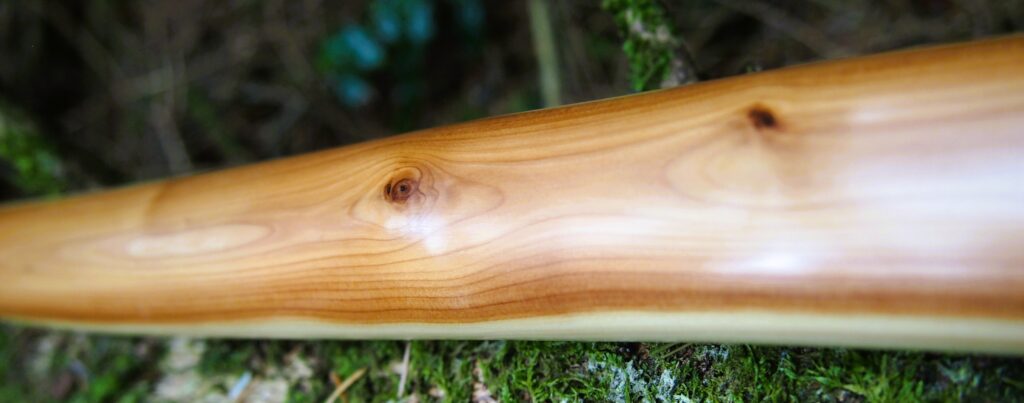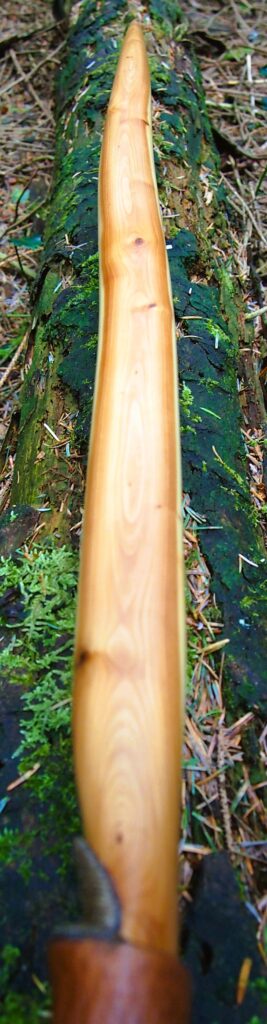
The stave I used to build this particular bow came from a storm damaged yew which had suffered the consequences of having had a massive oak tree fall right on top of it from some ones garden boundary back in 2023. It was brought to my attention by a tree surgeon mate of mine who was called in to clean the mess up.
Upon first inspection of the rather sad wreckage of what was a half decent sized mature yew (for around here at least), I didn’t expect to find anything other than possibly a billet or two. But to my absolute delight, and indeed surprise, I could see one solitary limb on the south side of the twisted broken mass of smashed branches, which had been completely missed by any part of the fallen oak.
Viewed from a distance it looked half decent at around 4-5” in diameter, but to be honest I was very much expecting upon further investigation to find the limb in question would be riddled with damage, side branches or other undesirable features. But instead, as if by miracle, I was further delighted to see that this solitary limb was not only fairly clean, but was almost perfectly straight along at least one angle when viewed side on.
Needless to say, for the princely sum of a few promised cold beers, I instructed my tree surgeon mate to CAREFULLY detach the limb so I could eye the stick over properly. And I was not disappointed. Nor was the lady whose garden had been trashed by the fallen oak, as whilst chatting to her as the chainsaws buzzed away, it turned out her late father used to build English longbows as a hobby when she was a young girl! You could not write it!! I swear we’re all in a simulation.
I got the limb home and inspected the ends of the log to see what the sapwood to heartwood ratio was like and inspect the growth ring configuration. And whilst the sap wood was a bit on the thick side measuring about half an inch thick at the fat end of the log, there was clearly plenty enough heartwood inside the log which would allow me to reduce the sapwood significantly without running out of belly wood outside of the pith line.
Now there has always been a lot of debate amongst the bowyer community regards what type of yew wood makes the best bows. Most of the advice passed around reflects upon the idea that thin growth rings dictate higher wood density and therefore the thinner ringed wood is stronger, therefore lending itself better to the purposes of providing for the needs of folk who like to fling arrows.
And whilst I have certainly found this general advice to hold some truth, especially with regard to yew timber which is growing straight up, I’m not at all convinced that this age old advice works well when we apply this logic to a side branch type stave, akin to the one I had before me on this occasion.
You see, a side branch of any tree is growing out horizontally. It does this to best expose it’s leaves/needles to the sunlight which would otherwise be masked by all the surrounding shad casting structure created by the canopy of the same trees own crown.
So a side limb, unlike a vertical growing “sucker” type limb, has to resist gravity each and every day of its existence due to its horizontal orientation. And it is this constant battle with gravity which is what causes the particular growth ring arrangement which you will always see in when looking at the ends of any side limb staves. Vertical growing limbs tend not to show the same ring configuration found in horizontally grown limbs unless the vertical limb is exposed to the prevailing wind. In that instance, the prevailing wind is acting like gravity by forcing the limb to withstand bending forces from a constant direction.
Take a good look at the end of any side limb stave whilst it is still in the round and you will quickly see that one side of the limb will have thin, tightly packed growth rings, whilst the opposite side of the limb will have much thicker, widely spaced rings. And the pith will be much closer to the more tightly ringed upper side of the limb. The limb I had just acquired was exactly this way.
All this visual info tells us precisely which side of the limb faced the sky when it was still attached to the tree, whilst simultaneously slapping us in the face with which side of the limb faced the ground. Thin rings faced the sky, fat rings faced the ground. Simple!
Does any of that matter I hear you say. Dam right it does! So pay attention to this next bit, especially if you are new to making bows out of timber you’ve paid hard earned beer money for!!
Those tight rings you saw in the cut end of your prized hunk of yew are telling you exactly where nature constantly exposed that limb to tension forces. And those thicker rings are screaming “I’m strong in compression!”
So which bit do we use then? We want wood that will give our bow a back which is strong in tension, but also a belly which is strong in compression. But we can’t use both halves of the limb, else we would just have a log, rather than a bow, right? Plus everyone says we want all that super dense tight ringy stuff right? Wrong!
In my experience of several decades working with mainly English yew in the form of less than 6” diameter side branch staves, you absolutely do NOT want to use the thin ringed side of a side limb type stave. Especially if the log in the round has a diameter of less than 4”. But let me explain why I’m telling you this before you call me an idiot and send me off to read the encyclopaedia Britannica of building English Longbows by the late legendary sole surviving participant of the battle of Agincourt, Dr. K. Now It’all.
Whilst all that tight ringed tension strong wood will indeed offer the bowyer a bow with a back which would be stronger than a rustic French cheese, that very same wood will produce a belly on a bow with the compression strength of one of them soggy prawn crackers which my local chippy hands out a bag of for free with orders over £30.
But if I were to use the heart wood as the bows belly from this side of the log, then I’d probably try heat treating it so that it would stand a better chance of standing up to all that tension strong sap wood. That said though, in my experience, belly wood from this thin ringed upper part of a horizontal limb will consist of all that pithy wood, which is really prone to splitting and checking when the heat gun comes out.
So why would the heart wood on the upper side of a horizontal side limb be weak in compression I hear you ask. Well it’s actually quite simple. It’s because the wood which sits on the skyward facing side of any side limb has one job to do. And that job is to resist gravity by being strong in tension. It is not expected to grow strong in compression because that’s the job of the side of the limb which grows facing the ground. And this goes for any species of tree, not just yew.
So what can we take away from this? Well the first thing to remember is that nature long ago realised the power of many thin layers. Those thin, tightly packed layers of growth rings are akin to the many thing laminations found in the blades crafted by master Katana sword smiths of ancient Japan, blades famous the world over for their tension strength. Insane force is required to break these relatively thin laminated blades which to this day are still famed for their durability, having been folded sometimes many hundreds of times.
The samuri didn’t care too much for blades with maximised compression strength you see. Make a blade too hard and it becomes hard to sharpen, prone to chip and most importantly, they become brittle. And brittle blades snap. Snapped blades aren’t much good in a sword fight. So strong, tension durable blades with good but not excessive hardness were more desirable than diamond hard blades.
I can’t help but wonder if our own medieval ancestors had a similar yearning for less destructible weaponry. I mean, If I was on a battle field, long bow in hand, would I be most concerned about the compression strength of the belly of my primary weapon, or would I care more about the tension strength of my bow’s back, and therefore the probability that it would not explode into kindling just as the opposition are charging. Hmmm, I think my bow staying in one piece might be more of a priority than a bit of string follow, don’t you!
But I back my bows. So do I really need the wood with all the tension strength? No I don’t. In fact a sinew backed, bamboo backed or even white wood lami backed bow is guaranteed to have a back which would be as strong as, if not stronger than, the very best yew sapwood on the planet.
My concern therefore is on using the best, cleanest and most compressing strong belly wood I can get out of a stave. Because a strong back, be it made by yew sapwood or an added backing like sinew/boo/ash etc, will over power a weak belly every time. And over time that over powering adds up to excessive string follow and possibly even crysaling on the belly. And whilst all the above might not produce a broken bow, it will produce a poor performing bow producing low arrow speeds and subsequently reduced cast.
These day I refrain from selling self bows. I just cant take the risk of someone buying and then mistreating a self bow only for it to end up being broken through misuse. And if one of my bows were to break at full draw then the possibility of someone getting hurt is not unreasonable. All it would take is for someone to leave a selfbow in a hot car or something similarly daft and BANG! And can you image the possible fall out if someone lost an eye or something. No chance
So every bow I sell nowadays has a bomb proof backing, both to maximise performance, as well as to mitigate risk. Risk not only to my customers welfare, but also to potential cause for litigation directed at myself or my business, because we are living in a time where common sense and personal responsibility appear in short supply, where as the blame culture appears the new norm.
Something else to consider when choosing which side of the limb to use as your bow is the location of all the difficult to work around features like knots and pins. Most side branch type limb staves will have the bulk of the knots and pins in the top and upper sides of the limb. And since the growth rings in this portion of the limb are much tighter, the heartwood mass will have less thickness of material between the bark facing the sky and the pith running through the limb. So often times the simply isn’t enough material in this side of the limb to make a bow. So once again we have more reasons to avoid the tension strong wood in the upper half of a horizonal growing side limb type stave.
By now you will have guessed that for this particular bow build I chose to use the downwards facing compression strong side of this particular limb stave. And I’m very glad I did. After 3 years of seasoning, the stave was pulled out of my barns rafters and the compression side of the log gave me a stave which was almost completely straight and with a good inch and 3/4 of relatively knot free heartwood before I hit the pith. I did end up leaving a bit of pith in the handle though, but since the handle on this build was going to be stiff, I did not need not worry about the pith providing a weakness.
After roughing out I homed in on a vague pyramidal flatbow type profile, 20″ of working limb each side, 10 inches of riser (4″ handle/3″ fades), and 8″ static tips. This would give me a 66″ bow nock to nock, which should be optimal for a 28″ draw. And I could see I had enough wood to make a 50ish pound bow.
After reducing the sapwood and letting the stave air for a week in the house, I put the stave onto a form which was very slightly reflexed overall, so that I could use the heat gun to knock of some of the unwanted and difficult side profile wiggle, and perfect the already quite good string alignment.
At this point the tips were only very slightly reflexed just like the whole stave was, so I was effectively tillering a straight stave to start. Once I had all 40″ of working limbs bending evenly, I flicked the 8″ static tips on a slight recurve form, re checked string alignment and sinew backed it. Off she then went for 6 months of curing time.
After a whole winter and spring of seasoning I could see that the sinew had pulled an inch or so of overall back set into the whole stave. This was fine and I envisaged most of that back set being lost after tillering was finished plus shooting in was completed, and sure enough this is what happened. The flicked tips held firm though and the limbs reverted back to straight though which landed her with about 2.25 inches of overall reflex after unstringing and resting. Perfect!
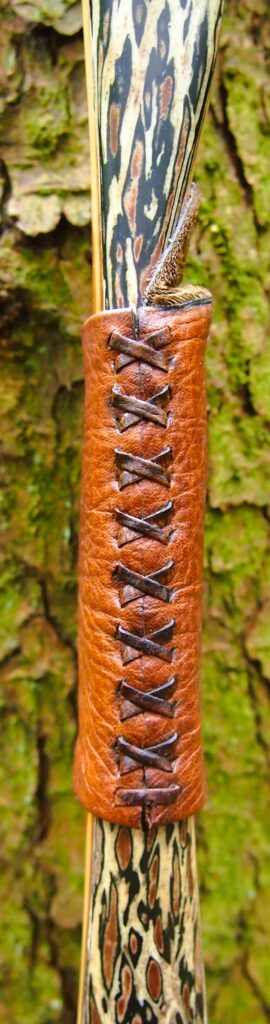
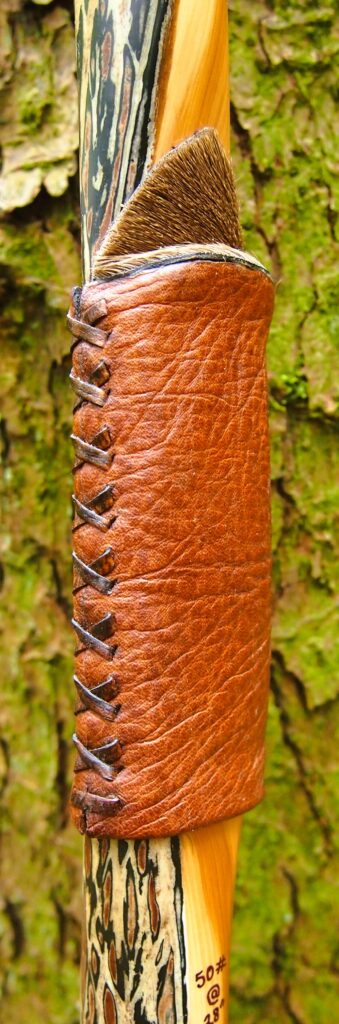
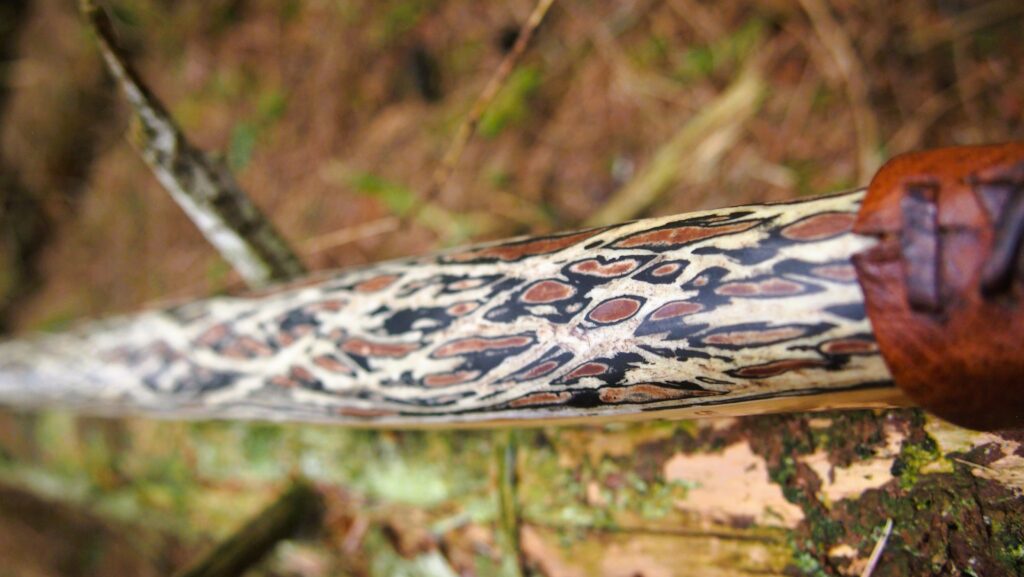
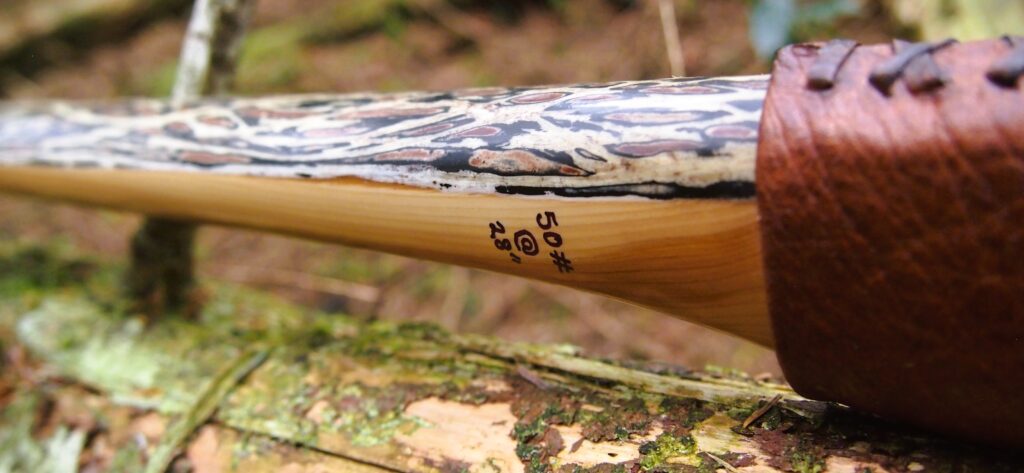
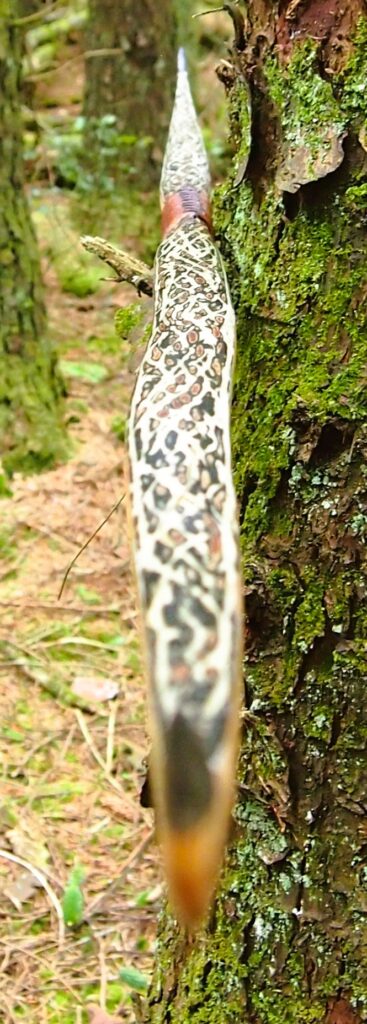
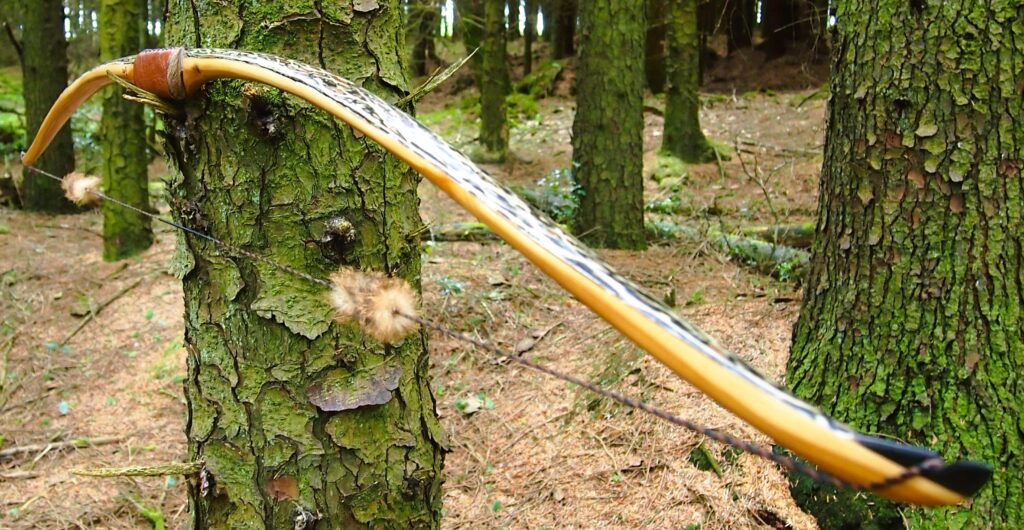
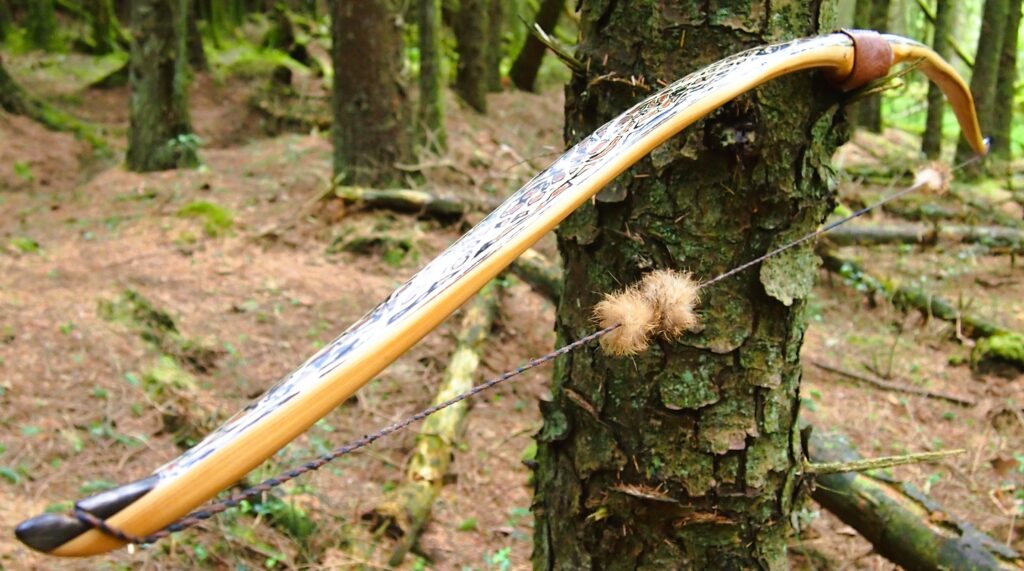
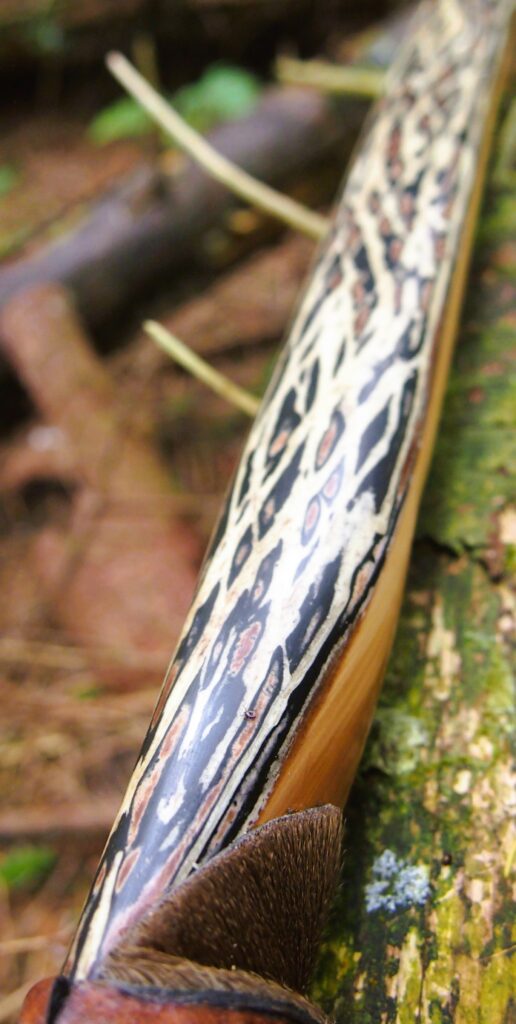
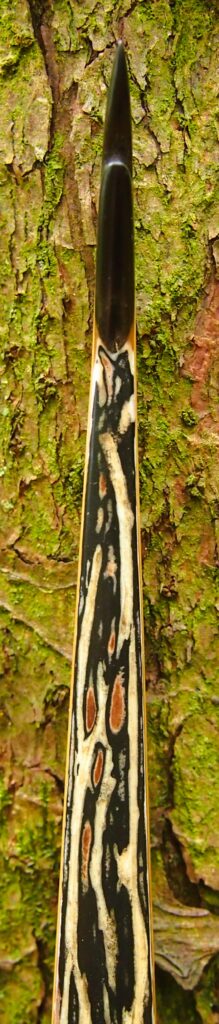
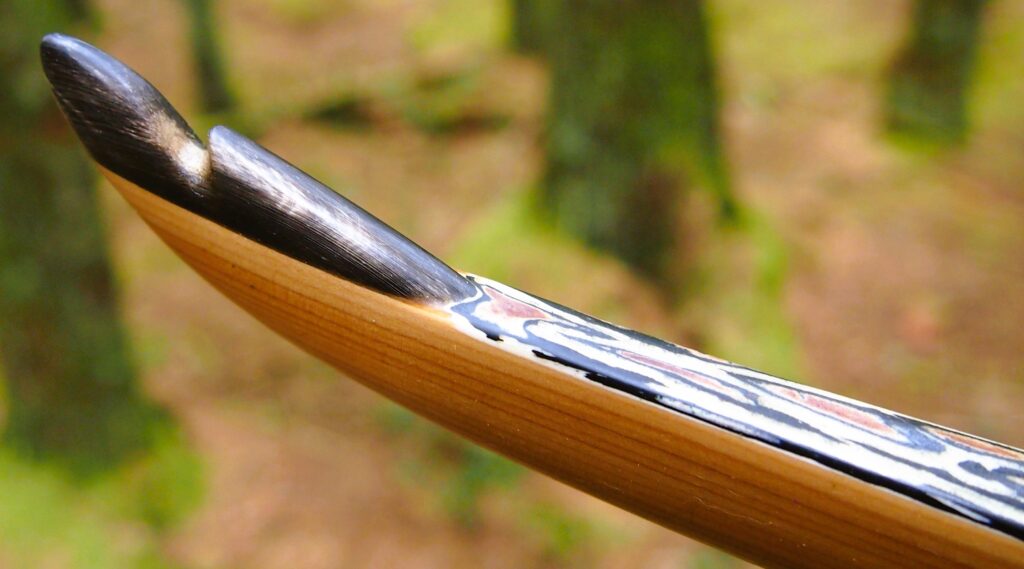
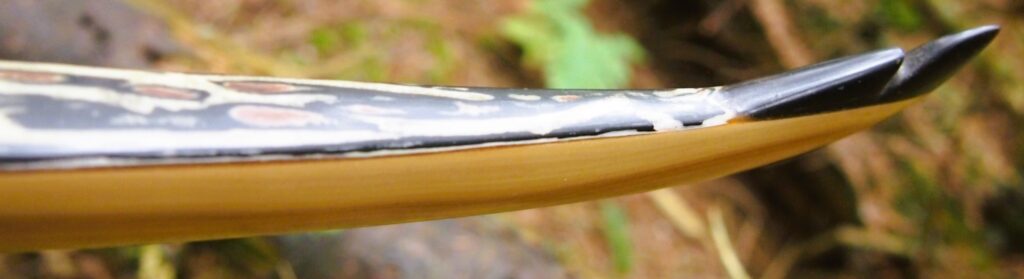
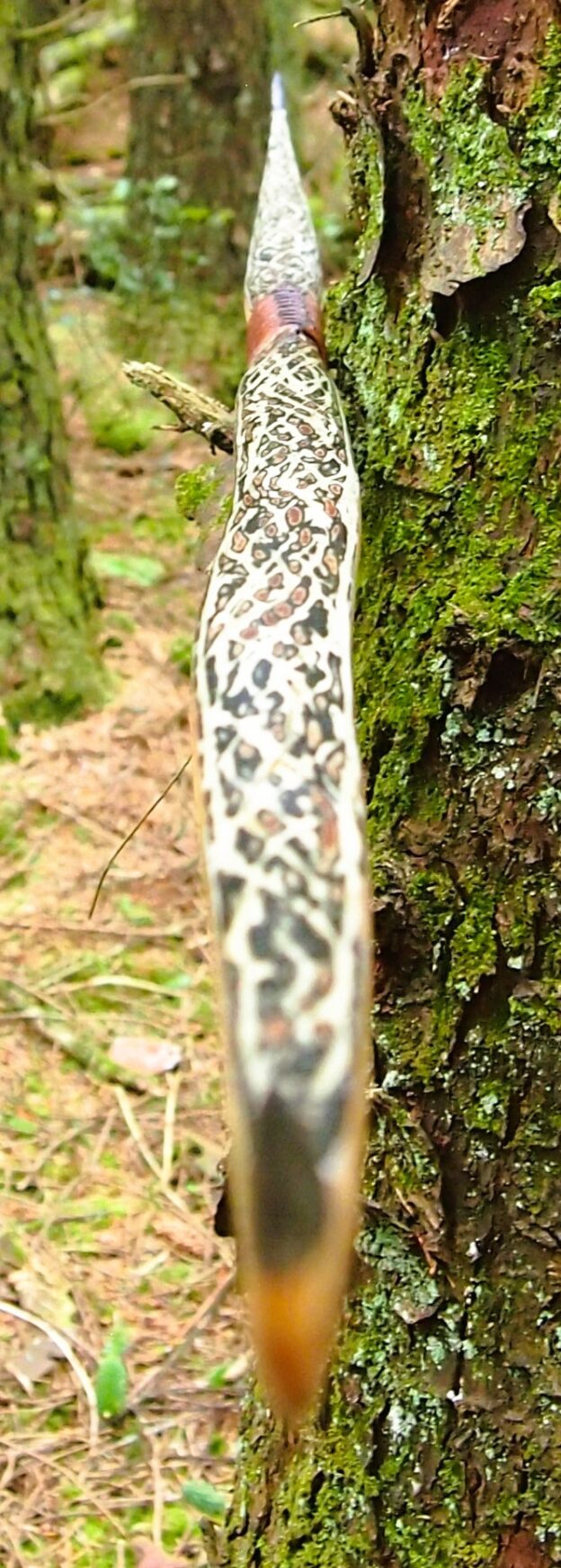
I managed to get 50 pounds of draw weight out of her as planned so got to finishing her up. For the tip overlays I fancied a nice bit of buffalo horn which had a little bit of grey streaking through it. Gorgeous stuff. For the sinew backing I wanted to create a camo, kind of birch bark type effect using my local earth pigments mixed with TB3, which would also water proof the sinew to a large degree.
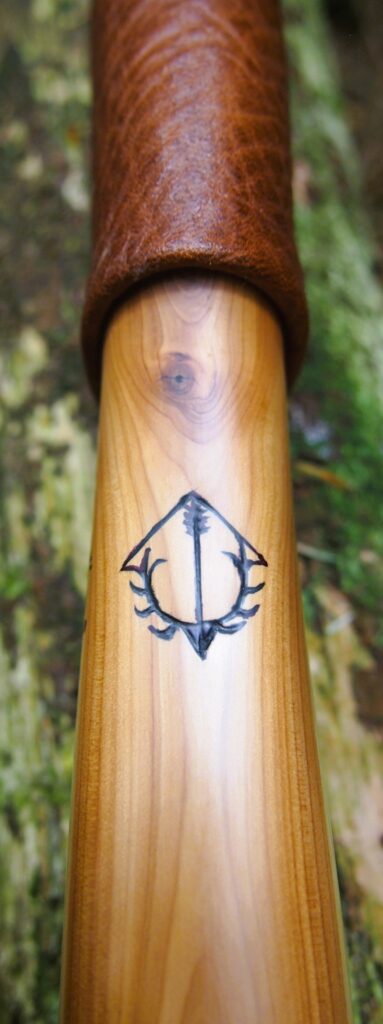
The handle was wrapped in a rather lovely piece of soft, wrinkled red deer stag neck leather which I had bark tanned myself using sitka spruce bark, a bark which makes beautiful red/tan hides. The leather handle wrap was fitted with contact cement and lashed on with some roe deer leather lace I made last year. The arrow pass is bark tanned red deer hair on shin leather, which is just a great and very hard wearing natural material which makes the arrow whisper quiet when leaving the bow.
The finish is a few primer coats of shellac followed by many layers of danish oil. After pumice polishing the cured oil finish, Bees wax/linseed paste wax gave her a wonderful satin sheen.
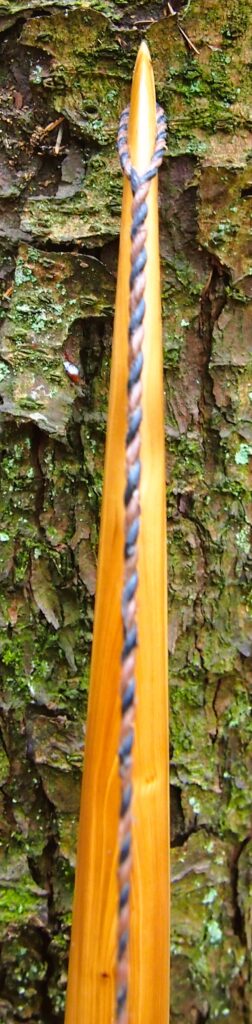
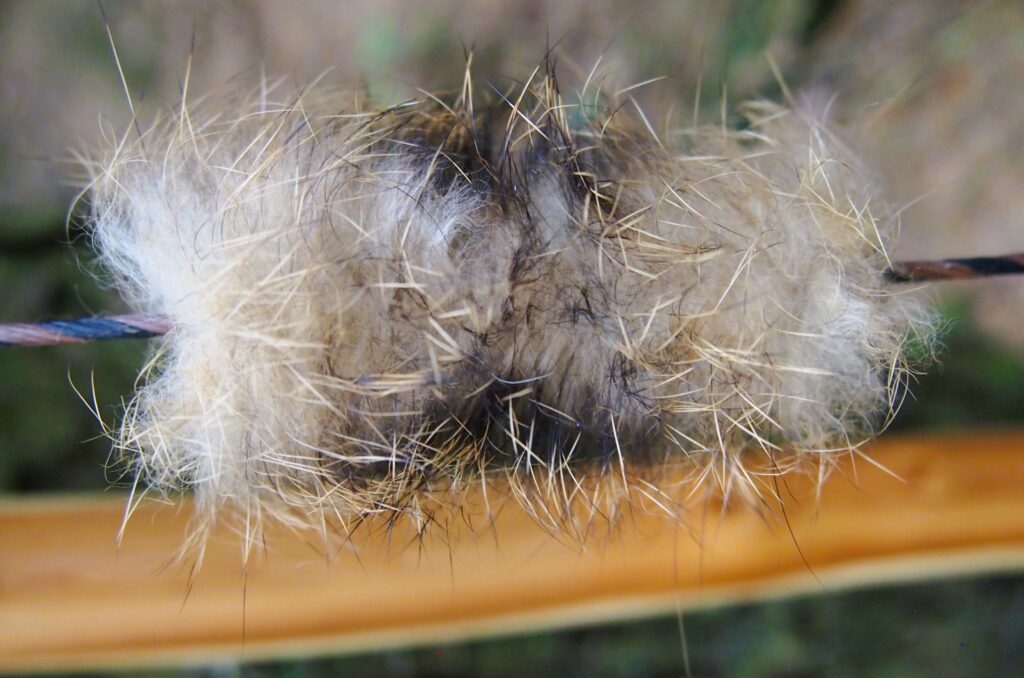
I made her up a B55 bow string with nice small loops which keep the string tracking straight on those super fine tips. Silencers are wild brown hare bark tanned fur and make the shot super silent.
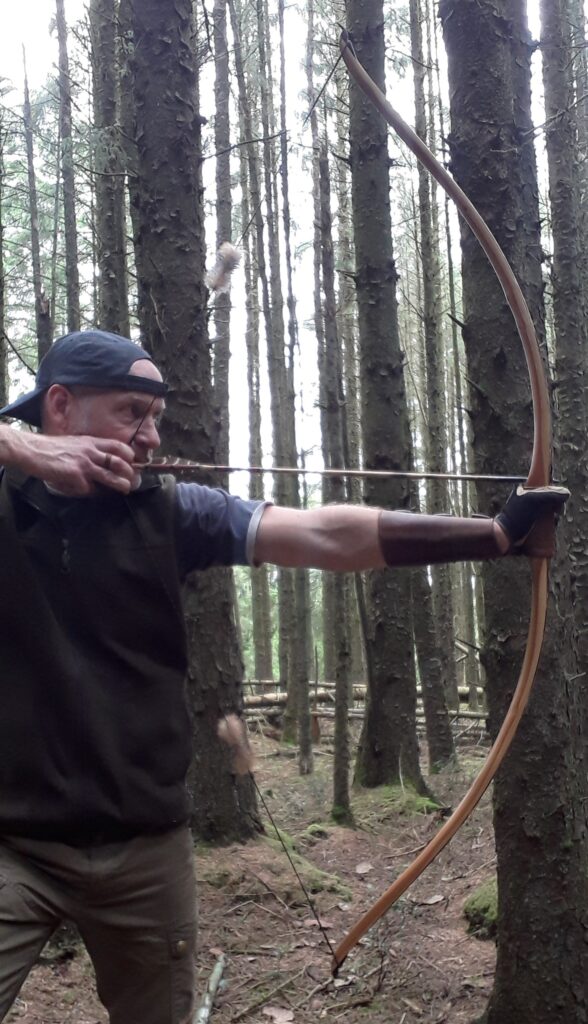
This bow turned out amazing. I loved shooting her in. One of my favorite bows for a while. Fast, quiet and little hand shock due to the low mass tips. She sends a 500 grain arrow over the chronograph at around 155 ft/sec and is just so much fun to shoot. And a real looker too.
Here are her stats:
Draw Weight: 50lbs at 28”
Mass: 825 grams
Length NTN: 66” (asymmetrical limb layout)
Width: 1 5/16″” at widest part
Tips: last 8” semi static reflexed, 3/8” wide
Back: Crowned with undulations. : Pyramidal face profile
Belly Profile: Working limb sections rounded D shaped, transitioning at the tips to a ridged cross section.
Tiller: Eliptical. 1/4” positive
Brace height: 5.5″
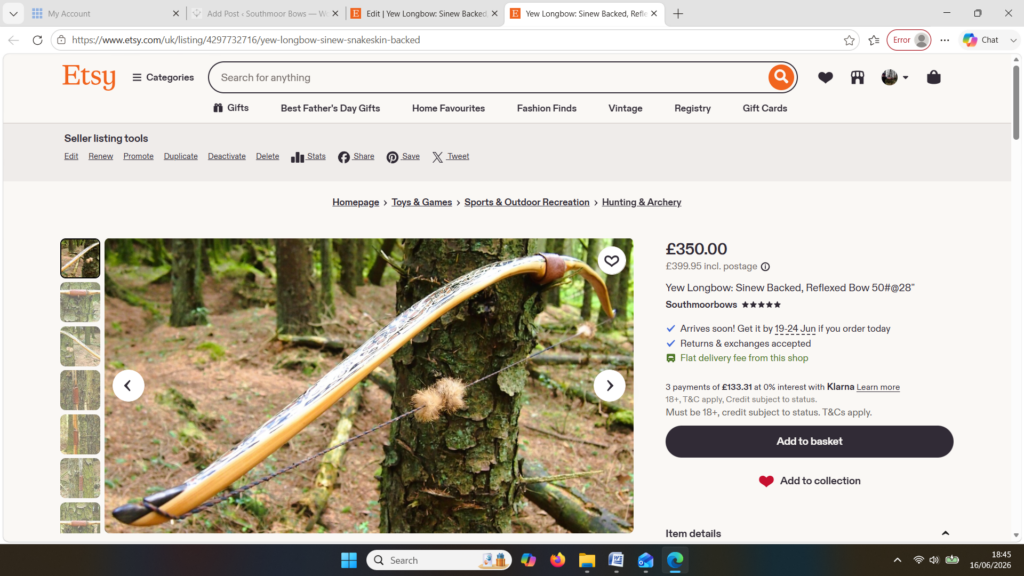
This bow is now ready for sale and will be listed in the Southmoor Bows Etsy shop. The listing can be found here: Yew Longbow: Sinew Backed, Reflexed Bow 50#@28″ – Etsy UK
Feel free to contact me with any questions either here through the contact page: Contact me
or through Our Etsy shop. I hope you enjoy the pictures and video and will have more bows to blog about shortly.
Until then, may your arrows fly true!